
Risks in many coastal developments and commercial buildings often begin forming long before construction starts, particularly when procurement strategies remain undefined during early project coordination. As project scale, wind pressure requirements, and system complexity continue to increase, procurement for developers, architects, and general contractors is no longer limited to pricing and lead times, but increasingly affects façade coordination in coastal procurement strategy, approval sequencing, and downstream construction execution.
In multi-unit projects especially, insufficient early coordination between commercial glazing systems, structural conditions, and construction schedules can cause localized procurement issues to expand into broader execution risks later in the project. As a result, more project teams are recognizing that procurement strategy in coastal developments is no longer purely a purchasing issue, but an important part of overall project risk control and execution predictability.
Procurement Delays In Coastal Projects Are Beginning To Impact Overall Construction Execution
In many coastal developments and commercial buildings, the impact of procurement delays is no longer limited to material arrival timelines, but is increasingly affecting construction sequencing and overall execution stability. As building envelope systems become more complex, the relationship between procurement coordination and construction execution is becoming significantly more interconnected.
In traditional project workflows, architectural design and façade development are often completed before supplier selection and system procurement begin. While this approach can still function in less complex projects, it creates growing coordination challenges in multi-unit developments and high-rise coastal buildings, where commercial glass systems, structural conditions, installation methods, and approval requirements are closely linked. Once system coordination is delayed until procurement stages, localized issues can quickly expand into broader execution problems.
For example, if project teams discover after façade coordination is completed that system dimensions, glazing configurations, or installation conditions do not align with project requirements, the resulting adjustments rarely remain isolated to the product itself. In many cases, they also affect drawing coordination, approval sequencing, fabrication planning, and site scheduling. In coastal regions especially, stricter wind load, water resistance, and certification requirements further reduce the range of compliant system options available to the project.
As system flexibility narrows, teams are often forced to resolve conflicts through redesign, supplier re-coordination, or accelerated procurement timelines. These adjustments not only increase coordination pressure, but can also disrupt fabrication lead times and façade installation sequencing. Problems that initially appear to be procurement-related often evolve into execution risks during later construction phases.
As a result, more developers are beginning to reassess the role of procurement within coastal projects. Procurement is no longer viewed solely as a matter of pricing and delivery management, but increasingly as a critical part of construction predictability and overall project stability.
Why Coastal Construction Projects Require Different Procurement Strategies
Coastal construction projects require different procurement strategies because façade systems in these environments are subject to significantly higher performance and coordination demands than those in conventional commercial developments. Procurement decisions are influenced not only by pricing and lead times, but also by wind load resistance, water penetration performance, certification compliance, installation conditions, and long-term durability requirements.
In many inland commercial projects, developers and contractors typically retain a wider range of acceptable system options throughout the design and procurement process. However, in coastal developments, higher wind exposure, stricter code requirements, and more complex envelope coordination significantly reduce the number of systems that can realistically satisfy project conditions.
This fundamentally changes the role of procurement within the project workflow. Instead of functioning as a purchasing activity after design completion, procurement in coastal projects increasingly becomes part of early-stage technical coordination. Developers, architects, façade consultants, and general contractors are often required to evaluate system feasibility much earlier in order to avoid conflicts between structural assumptions, façade geometry, and certified performance limitations.
The challenge becomes even more pronounced in multi-unit developments and high-rise commercial buildings where commercial glazing solutions must align simultaneously with structural attachment conditions, approval pathways, fabrication timelines, and installation sequencing. Once procurement coordination is delayed, projects frequently reach a point where systems initially assumed to be viable can no longer satisfy actual performance or installation constraints.
As a result, coastal projects operate with far less downstream adjustment tolerance than standard developments. Procurement strategy is therefore no longer about purchasing flexibility, but about establishing system-level constraints early enough to maintain coordination stability, approval predictability, and execution control throughout the project lifecycle.
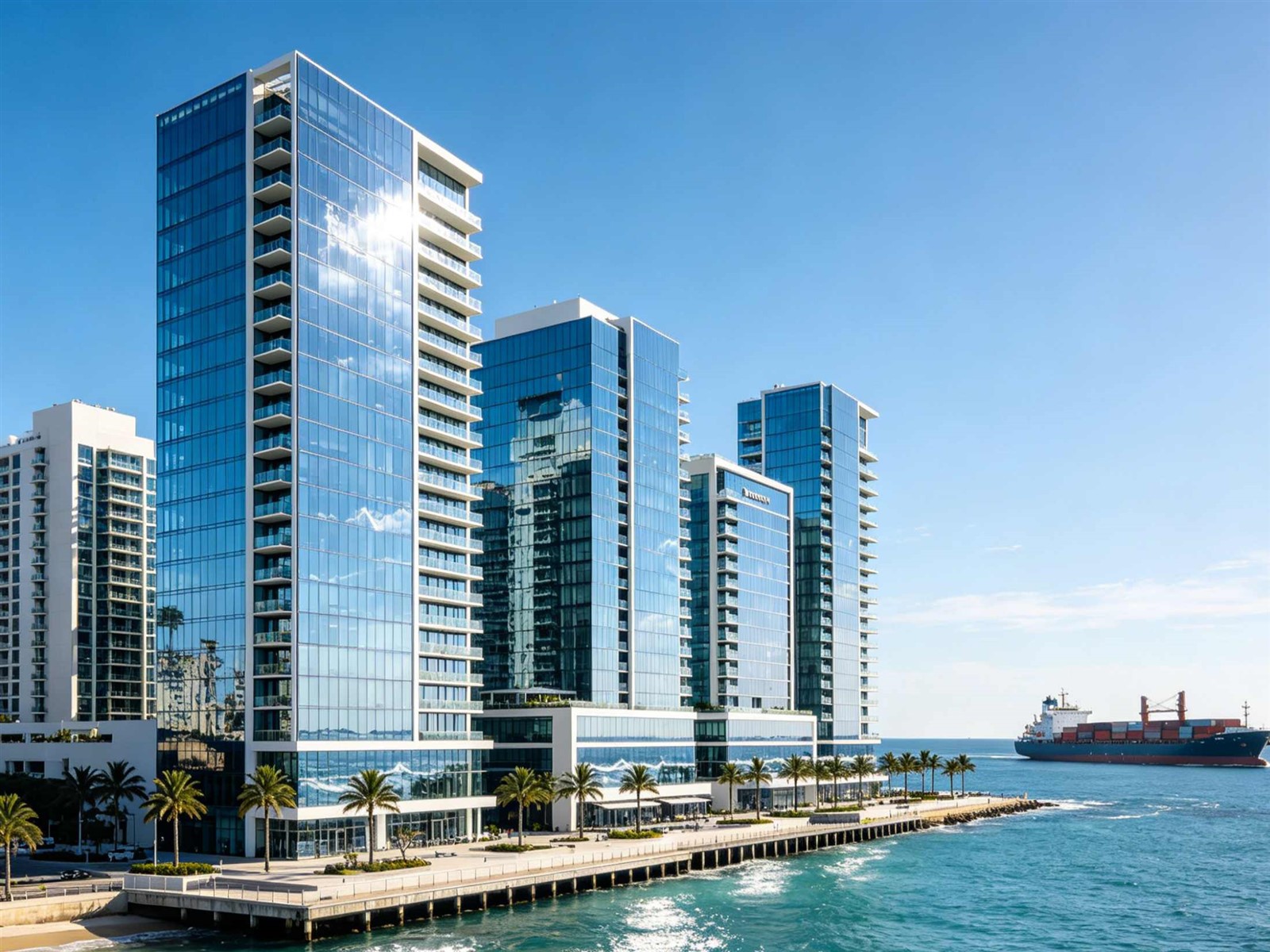
Procurement Timing Is Directly Influencing Façade Coordination And Construction Sequencing
In coastal construction projects and commercial buildings, procurement timing is increasingly becoming a determining factor in façade coordination outcomes rather than a downstream procurement activity. When commercial facade glazing systems are introduced too late in the design process, façade development is often already based on assumptions regarding system dimensions, anchoring conditions, and installation methods that have not been fully validated against actual system constraints.
At the façade coordination stage, architects, façade consultants, and general contractors are required to translate design intent into constructible system interfaces. This includes aligning opening dimensions, structural supports, connection details, and waterproofing strategies with specific system requirements. If procurement decisions have not yet been finalized, coordination is often carried out using placeholder assumptions rather than verified system data, which increases the likelihood of misalignment between design intent and execution feasibility.
This issue becomes more pronounced in multi-unit developments and high-rise commercial buildings, where façade systems are not isolated components but integrated elements of the building envelope system. Delayed procurement of commercial glass systems often triggers iterative redesign cycles, as previously defined façade geometries may not align with certified system limitations or installation tolerances.
As coordination progresses, these inconsistencies begin to directly affect construction sequencing. Fabrication schedules, delivery windows, and installation planning are all dependent on finalized system definitions. When procurement timing is delayed, contractors are often forced to compress sequencing, overlap design and procurement phases, or adjust installation logic on-site in order to maintain project progress.
In coastal developments, where wind load requirements and certification constraints further restrict system flexibility, the impact of delayed procurement becomes even more critical. What initially appears to be a scheduling issue at the procurement level often evolves into a structural coordination constraint that affects façade completion, interior sequencing, and overall project delivery milestones.
As a result, procurement timing is no longer an administrative step in project delivery. It is increasingly functioning as a control point that directly determines the stability of façade coordination and the predictability of construction sequencing across the entire project lifecycle.
Why Developers Are Starting To Evaluate Commercial Glazing Systems Earlier In The Design Phase
Developers are increasingly evaluating commercial facade glazing systems earlier in the design phase because system-related constraints are no longer isolated technical considerations, but factors that directly influence downstream project feasibility. In coastal construction projects and commercial buildings, façade systems are tightly linked to structural design, approval pathways, procurement sequencing, and construction planning, which means late-stage evaluation often leaves insufficient flexibility for meaningful adjustments.
In traditional project workflows, system selection was typically treated as a procurement-stage decision after architectural concepts and façade schemes had already been defined. However, this sequence is becoming less viable in multi-unit developments and high-rise coastal projects, where architectural glazing systems must comply with strict wind load requirements, installation limitations, and certification boundaries. As a result, design decisions made without early system validation tend to become progressively locked into assumptions that are difficult to reverse later in the process.
As a result, developers are recognizing that many execution risks do not originate during procurement or construction, but are embedded much earlier in the design development process. When system feasibility is not evaluated early, façade geometry, structural openings, and installation strategies may all be defined without alignment to actual system capacity, creating structural mismatches that only surface during later coordination or approval stages.
This is particularly critical in coastal developments, where system flexibility is inherently limited. Building envelope glazing systems in these environments are not interchangeable components, but certified assemblies with defined performance ranges and installation conditions. Once these boundaries are exceeded by design assumptions, project teams often face limited options: redesign, system substitution, or cross-disciplinary coordination rework.
For developers, early evaluation of commercial glazing solutions is therefore no longer about optimizing procurement timing alone. It is becoming a project-level risk control mechanism that defines whether system constraints are properly integrated before architectural and structural decisions become difficult to adjust. By shifting evaluation upstream, developers can improve coordination stability, reduce redesign exposure, and maintain greater predictability across approval, procurement, and construction execution.
Supply Chain Coordination Is Becoming More Critical Than Product Pricing In Large Commercial Projects
In large commercial buildings and coastal developments, procurement decisions are increasingly influenced by supply chain coordination capability rather than product unit pricing. As projects become more complex in terms of façade systems, structural interfaces, and compliance requirements, the ability of a supplier to manage fabrication sequencing, delivery reliability, and multi-stage coordination is becoming a determining factor in project execution stability.
In multi-unit projects and high-rise developments, commercial glass systems are rarely procured as standalone products. Instead, they are integrated into a broader delivery chain that includes design coordination, engineering validation, certification alignment, manufacturing scheduling, and installation sequencing. Under these conditions, even competitively priced systems can create significant downstream risks if the supply chain lacks the capability to respond to design adjustments or phased construction requirements.
This is particularly evident in coastal projects, where commercial facade glazing systems must comply with stricter wind load and performance certifications, often requiring more complex fabrication processes and tighter tolerance control. Once procurement is disconnected from supply chain execution capability, projects may face delays not because of material cost issues, but due to coordination breakdowns between design updates, production slots, and installation readiness.
As a result, developers and general contractors are increasingly evaluating suppliers not only on product specifications, but also on their ability to maintain synchronized delivery across design iteration cycles and construction milestones. In this context, supply chain reliability becomes a form of risk mitigation rather than a procurement preference.
For many stakeholders, this represents a structural shift in procurement logic. Cost remains a relevant consideration, but it is no longer a primary decision filter in complex coastal and commercial projects. Instead, procurement outcomes are increasingly determined by whether the supply chain can support continuous coordination across design development, certification requirements, and construction sequencing without introducing execution disruption. In this context, coordination capability becomes a prerequisite for maintaining schedule certainty and hurricane impact systems delivery reliability, rather than an optional supplier advantage.
Why Delayed System Procurement Leads To Approval And Compliance Coordination Issues
Delayed system procurement often creates approval and compliance coordination issues because certification requirements are inherently system-specific rather than concept-based. In coastal construction projects and commercial buildings, regulatory approval is not only based on architectural intent, but also on whether the selected systems meet verified performance criteria, including wind load resistance, impact performance, water penetration limits, and tested installation configurations.
In early design stages, façade geometry, opening dimensions, and structural layouts are often developed without confirming final system selection. This means that many assumptions embedded in drawings are not yet aligned with certified commercial glazing solutions. When procurement decisions are delayed, these assumptions are carried forward into submission and approval processes, where they are evaluated against real system constraints for the first time.
At the approval stage, authorities and consultants typically require confirmation that selected systems fall within certified ranges, including dimensional limitations, anchoring conditions, and installation methods. If system procurement has not been finalized, design submissions may rely on placeholder specifications that do not correspond to any approved product system. This creates a structural gap between design documentation and compliance validation.
This gap becomes more critical in coastal and high-rise developments, where certification frameworks are stricter and system options are more limited. Even minor deviations in opening size or structural detailing can invalidate system compliance, requiring redesign, resubmission, or system substitution. In many cases, approval delays are not caused by regulatory complexity itself, but by the absence of validated system data during the design submission phase.
As a result, delayed procurement does not only affect purchasing timelines, but also directly impacts approval predictability and compliance stability. Once system constraints are introduced too late, coordination shifts from proactive validation to reactive correction, increasing uncertainty across both regulatory review and downstream project scheduling.

Procurement Flexibility Rapidly Narrows After Structural And Façade Decisions Are Fixed
Once structural systems and façade schemes are finalized in commercial buildings and coastal developments, the flexibility available for procurement decisions decreases rapidly. At this stage, key parameters such as opening dimensions, load-bearing conditions, façade grid coordination, and interface detailing have already been locked into the design framework, leaving limited room for later adjustment without triggering broader system-level revisions.
In early design phases, procurement options typically appear flexible because system boundaries are still not fully defined. Developers, architects, and general contractors may assume that product selection can be optimized later based on pricing, availability, or supplier capability. However, once structural layouts and façade configurations are confirmed, these assumptions begin to shift into fixed constraints that directly determine what systems can be technically and compliantly implemented.
This is particularly critical in multi-unit projects and high-rise coastal developments, where commercial glass systems must align with tightly controlled structural grids, wind load requirements, and certification conditions. Any procurement adjustment at this stage is no longer an isolated product change, but often requires coordination across structural design, façade engineering, and approval documentation.
As a result, the later procurement decisions are made, the more they are constrained by previously finalized design conditions. What appears to be a purchasing decision is, in reality, already bounded by architectural and structural commitments established earlier in the project lifecycle.
Beyond this point, most adjustments require redesign-level coordination rather than supplier substitution, significantly increasing interdisciplinary complexity and reducing the range of viable procurement strategies.
Early System-Level Procurement Planning Is Improving Construction Controllability In Multi-Unit Projects
Early system-level procurement planning is increasingly being adopted in multi-unit developments and coastal construction projects as a means of improving construction controllability. Rather than treating procurement as a downstream purchasing activity, project teams are beginning to integrate system selection into early design coordination in order to stabilize façade interfaces, reduce certification uncertainty, and maintain alignment between structural conditions and installation requirements.
In large-scale commercial buildings, commercial glazing systems are no longer independent components but part of an interconnected delivery framework involving structural design, façade engineering, approval processes, and construction sequencing. When system-level decisions are made early, key parameters such as opening dimensions, anchoring conditions, and performance requirements can be validated before they are locked into irreversible structural and façade commitments.
This early alignment significantly reduces the risk of late-stage redesign and coordination disruption. In multi-unit projects especially, where repeated façade modules and standardized installation processes are critical to maintaining construction efficiency, early system definition helps establish consistent technical boundaries across all units. This improves fabrication predictability, simplifies installation planning, and reduces variation-driven coordination issues during execution.
In coastal developments, where system performance requirements such as wind load resistance, water penetration control, and certification compliance impose stricter limitations, early procurement planning also plays a critical role in maintaining approval stability through lifecycle cost analysis. By confirming system feasibility during the design phase, project teams can avoid downstream conflicts between design intent and certified system constraints.
It enables developers, architects, and general contractors to transition from reactive coordination cycles to structured system-based planning, improving schedule predictability and reducing execution uncertainty across the project lifecycle.