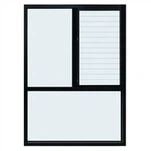

In contemporary residential architecture, doors and windows are no longer merely auxiliary components of the building envelope. They are not only an important part of the building facade but also key factors affecting living comfort, safety, and energy efficiency. With the continuous evolution of housing types and increasing demands for building performance, more and more projects are beginning to re-examine the structural logic and usage of window types themselves. Against this backdrop, tilt and turn window designs have gradually evolved from regional selections into a representative, systematic window solution.
From an architectural design perspective, traditional window types such as casement, sliding, and top-hung windows often address a single problem: either emphasizing ventilation, pursuing ease of operation, or serving the rhythm of the facade. The design philosophy of inward-opening and tilt-and-turn windows is significantly different. It doesn't aim for "ultimate optimization" of a single function but rather attempts to establish a balance between ventilation, safety, cleanliness, sealing, and flexibility of use. This balance is precisely one of the core values pursued by modern residential architecture.
In actual projects, many designers or developers initially focus on this window type not so much for aesthetic reasons, but rather because of observations of residential behavior. For example, in mid- to high-rise residential buildings, achieving effective ventilation while ensuring safety has always been a challenging issue. Outward-opening windows pose wind pressure risks in high-rise environments, sliding windows have inherent limitations in sealing and energy efficiency, and single top-hung windows are insufficient for daily ventilation and cleaning needs. It is under these multiple constraints that the inward-opening and tilt-and-turn structure, with its dual-mode opening mechanism, begins to demonstrate its systemic advantages.
From a usage perspective, the inward-opening window sash provides controlled ventilation. Air can enter the room steadily, while avoiding problems such as strong winds and rainwater backflow. This ventilation method is particularly suitable for residential environments with large day-night temperature differences or where prolonged air circulation is required. When large-area ventilation or glass cleaning is needed, the inward-opening mode provides a complete opening angle, and the operation path is always on the indoor side, which has very practical safety significance for high-rise residential and apartment projects.
More importantly, this design is not simply a matter of "overlaying" two opening methods together; it places higher demands on the hardware system, profile structure, and installation precision. Therefore, tilt-and-turn window designs often play a role in building systems closer to a "mature solution" than a standard window type that can be easily replaced. This is particularly evident in new residential projects.
In the design phase of new residential buildings, the choice of window type is often highly related to facade proportions, interior functional layout, and overall energy-saving strategies. Inward-opening and tilt-and-turn windows, because their opening mechanism extends entirely inwards, encroach on outdoor space by almost zero. This gives them greater design freedom in high-density housing, urban renewal projects, and buildings with limited balcony dimensions. Designers can more easily manage the relationship between facade lines and shading systems without sacrificing ventilation performance.
Meanwhile, the advantages of this type of window in terms of sealing structure are gradually being incorporated into the overall building performance evaluation system. Multi-point locking structures and continuous sealing paths enable the window sash to achieve stable airtightness and watertightness when closed. This does not mean that a single window type can determine a building's energy efficiency rating, but it often serves as a reliable fundamental variable in the overall performance of the building envelope, thus providing greater flexibility for subsequent energy-saving design.
In some mature markets, inward-opening and tilt-and-turn windows are not discussed as standalone "products," but rather as part of the residential window and door system, forming a complete logic together with glass configuration, installation details, and usage scenarios. This systemic perspective is precisely what many new residential projects most easily overlook in the early decision-making stages. Once window type selection is postponed to the construction phase, compromises are often made under limited conditions, preventing the full realization of its design potential.
Therefore, when discussing tilt & turn window designs, what truly deserves attention is not just the opening method itself, but the "long-term use-oriented" design philosophy it embodies in residential buildings. This philosophy emphasizes the stability of daily experience, the clarity of safety boundaries, and the predictability of building performance at different stages of use. It is under this logic that this type of window has gradually transformed from an "optional solution" to a "preferred option" in an increasing number of residential projects.

In real-world projects, there is no universal "template" for tilt-and-turn windows. Even within the same country or climate zone, different housing types will have significantly different emphases on window systems. This difference doesn't stem from design preferences themselves, but rather from variations in building usage, maintenance logic, and long-term performance goals. Therefore, the application of tilt and turn window designs in new residential buildings often requires a reinterpretation of the specific scenario, rather than simply applying existing experience.
For example, low-density housing and mid-to-high-rise apartments have fundamentally different focuses in window design. In detached or townhouses, windows primarily function to connect with the outdoor environment. Views, lighting, and interaction with courtyard spaces often take precedence over safety controls under extreme conditions. Therefore, in these projects, tilt-and-turn window designs often emphasize the comfort of the opening size and the intuitiveness of operation. The proportions of the window sash, the space occupied when open, and its relationship with interior furniture placement are all carefully considered in the early design stages.
In multi-story or high-rise residential buildings, the role of windows changes significantly. Safety boundaries become an unavoidable prerequisite, especially in children's play areas, bedrooms, and public areas. The limited opening provided by the tilt-and-turn window is not merely an "additional function" in such projects, but directly affects whether the building can meet usage requirements without adding extra safety features. It is in this context that the dual-opening logic of tilt-and-turn windows is gradually being seen as a more "stable" solution.
However, many projects, when introducing this window type, often only focus on the opening method itself, neglecting the long-term impact of system differences. In reality, what truly determines the user experience is not just whether the window sash can tilt or open inwards, but whether the entire system has clearly defined boundary conditions during the design phase. For example, whether the window sash size matches the hardware's load-bearing capacity, whether the profile structure provides sufficient rigidity for the dual-opening mode, and whether the installation joints can maintain sealing performance over the long term. If these factors are not considered in the early stages, even changing product models later will hardly solve the fundamental problem.
From a design and construction coordination perspective, inward-opening and tilt-and-turn windows often place higher demands on project management than conventional window types. Due to their relatively complex structure, any deviation in details can be magnified during the usage phase. For example, insufficient installation precision may lead to uneven stress on the window sash, affecting opening smoothness; improper control of seal compression may result in decreased airtightness after several years. These problems are often not obvious at the initial delivery stage, but they directly impact users' long-term perception of the overall living quality.
For this reason, some experienced developers are beginning to move window system decisions forward to the architectural design phase, rather than waiting until construction drawings are completed. In this model, inward-opening and tilt-and-turn windows are no longer isolated components but are discussed in conjunction with facade composition, shading systems, and interior functional layout. This collaborative approach allows the advantages of the window type to be fully realized in the project, rather than being continuously limited and weakened later on.
Regarding the relationship between energy conservation and comfort, this type of window also demonstrates the value of systematic design. Inward-opening and tilt-and-turn windows typically utilize multiple sealing systems to form a relatively stable building envelope when closed. This doesn't mean a single window type can "solve the energy consumption problem," but given a well-designed overall building envelope, it can significantly reduce uncontrollable energy loss, making the building's thermal performance more predictable. For residential projects emphasizing long-term operating costs, this predictability is itself a significant value.
It's important to note that design rationality does not automatically translate into user satisfaction. If inward-opening and tilt-and-turn windows are merely seen as a "more advanced" feature in project decision-making, without understanding user behavior, even a system with good performance may be misused or used infrequently in real life. For example, in some residences, if the interior space layout and opening direction are not coordinated, the inward-opening state can become an inconvenience in daily life. This type of problem is not a product defect, but rather a result of a lack of holistic thinking during the design phase.
Therefore, when discussing inward-opening and tilt-and-turn windows in new residential projects, the truly mature approach is not to pursue a single "standard answer," but rather to understand the real needs of different living scenarios and set reasonable boundaries for system design. Only under this premise can the flexibility and safety inherent in the window type itself be transformed into long-term stable use value, rather than being gradually ignored after delivery.
In the post-project reviews of many residential projects, a recurring phenomenon is that while the window type itself wasn't wrong, the final result was still unsatisfactory. The problem often lies not in the product's performance parameters, but in the decision-making process itself. Especially under tight project schedules or significant cost pressures, window type selection is easily reduced to a "replacement" rather than part of the system design. This approach tends to amplify risks when dealing with inward-opening and tilt-and-turn windows, which require high system coordination.
From a design management perspective, what truly determines the value of a window type is not whether a particular opening method is adopted, but whether it finds a suitable place within the overall design logic. If the window type selection occurs after the architectural design is largely finalized, then no matter how mature the product itself is, its potential will be significantly limited. Conversely, if the window type is considered an important component of the building envelope in the early stages of discussion, many subsequent issues can often be resolved in advance.

In new residential projects, this kind of forward-thinking is particularly important. New homes are not products for short-term delivery, but rather architectural entities that require long-term use, maintenance, and upgrades. As one of the most frequently used components, the stability and adaptability of windows will be continuously tested over the years and even decades to come. The advantage of inward-opening and tilt-and-turn windows in this regard is not reflected in a single indicator, but in their ability to accommodate various usage scenarios.
In actual use, residents' evaluations of windows are often subjective, yet highly representative. Whether it's convenient, reassuring, or easy to maintain-these seemingly "non-technical" feedbacks precisely determine the true performance of a window type in a project. The controlled ventilation provided by the tilt-and-turn mode makes residents more willing to keep windows open in daily life, thereby improving indoor air quality; while the inward-opening mode provides sufficient operational space for cleaning and emergency use. This ability to switch freely between different situations allows window types to better adapt to real life, rather than forcing users to adapt to the design.
From a long-term maintenance perspective, system maturity is equally important. All window types experience wear and tear and performance degradation during their lifespan, but systems with clear structures and well-defined stress paths tend to have their lifespan extended through maintenance. Inward-opening and tilt-and-turn windows, due to their relatively fixed hardware systems and opening logic, actually offer higher predictability for later maintenance, provided reasonable standards are established during the design and installation phases. This is a realistic and quantifiable consideration for developers focused on overall asset value.
When we re-examine this from the perspective of industry development, we find that the widespread adoption of inward-opening and tilt-and-turn windows is not a result of a trend, but rather a natural product of residential buildings continuously seeking a balance between safety, comfort, and energy efficiency. As building codes and residential needs evolve, window type selection is no longer an isolated technical decision, but rather a reflection of the maturity of the building system. Against this backdrop, it is only natural that tilt-and-turn window designs are increasingly being incorporated into early-stage project discussions.
It's important to emphasize that this design approach doesn't mean all residential projects must use the same window type. Truly professional judgment isn't simply about "choosing a more complex solution," but about finding the most reasonable system configuration based on an understanding of the project's constraints. For certain specific scenarios, traditional window types still have irreplaceable advantages; however, in new residential buildings that need to balance safety, ventilation, and long-term performance, the system balance provided by inward-opening and tilt-and-turn windows is particularly valuable.
Returning to the project decision itself, a mature residential design doesn't strive for perfection at every stage, but rather establishes sufficient safety boundaries and usability flexibility in key areas. As a crucial interface connecting the interior and exterior environments, the design quality of windows directly impacts the building's performance throughout its entire lifecycle. When window types are incorporated into a systemic approach, rather than being treated as an afterthought, the overall completion of the building will improve.
Therefore, the significance of discussing tilt and turn window designs lies not in endorsing any particular window type, but in using this case to re-examine the position of residential doors and windows within the building system. Only by establishing a systematic and forward-looking decision-making logic during the design phase can window types truly become a contributor to improving the quality of housing, rather than a weak link that is repeatedly questioned after delivery.